The leader you are isn’t always the leader you need to be
Have you ever walked out of a meeting wondering if you should’ve shown up differently as a leader? More confident. More assertive. More challenging. Less amenable. Less expressive. Just…something different. A different style?

04/11/25
It’s a familiar loop for many in leadership roles. You are, in any single moment, attempting to read the room, adapt to needs, think strategically, communicate clearly, focus on results, hold the room, and maintain your credibility – whilst being authentically you. It is a real artform to constantly meet an unspoken expectation of what a “real leader” looks like.
But the truth is: you already have a natural “real” leadership style. The question isn’t whether it’s good enough. It’s how to use it well, and how (and when) to stretch and adapt it for greater impact.
There is no “one-size-fits-all” for great leadership. The most effective leaders aren’t locked into one mode; they’re deliberate, agile, and deeply aware of how their leadership choices shape outcomes, culture, and performance at scale.
Your leadership brand: it starts with you
We often work with clients on helping leaders to understand their leadership brand – nothing performative or glossy, but an exploration into a deeper, clearer understanding of what they stand for, the difference they bring and the value they create in their leadership.
This is a great starting point to help guide your awareness of your Leadership Style – the way that you lead that is your most comfortable – especially under pressure.
But in the face of unprecedented and accelerating change, coupled with the varied set of attitudes, mindsets, behaviours and values across the people you lead, situations will arise where your default style is not always what’s needed.
“The best leaders don’t know just one style of leadership – they’re skilled at several, and have the flexibility to switch between styles as the circumstances dictate.”
Daniel Goleman
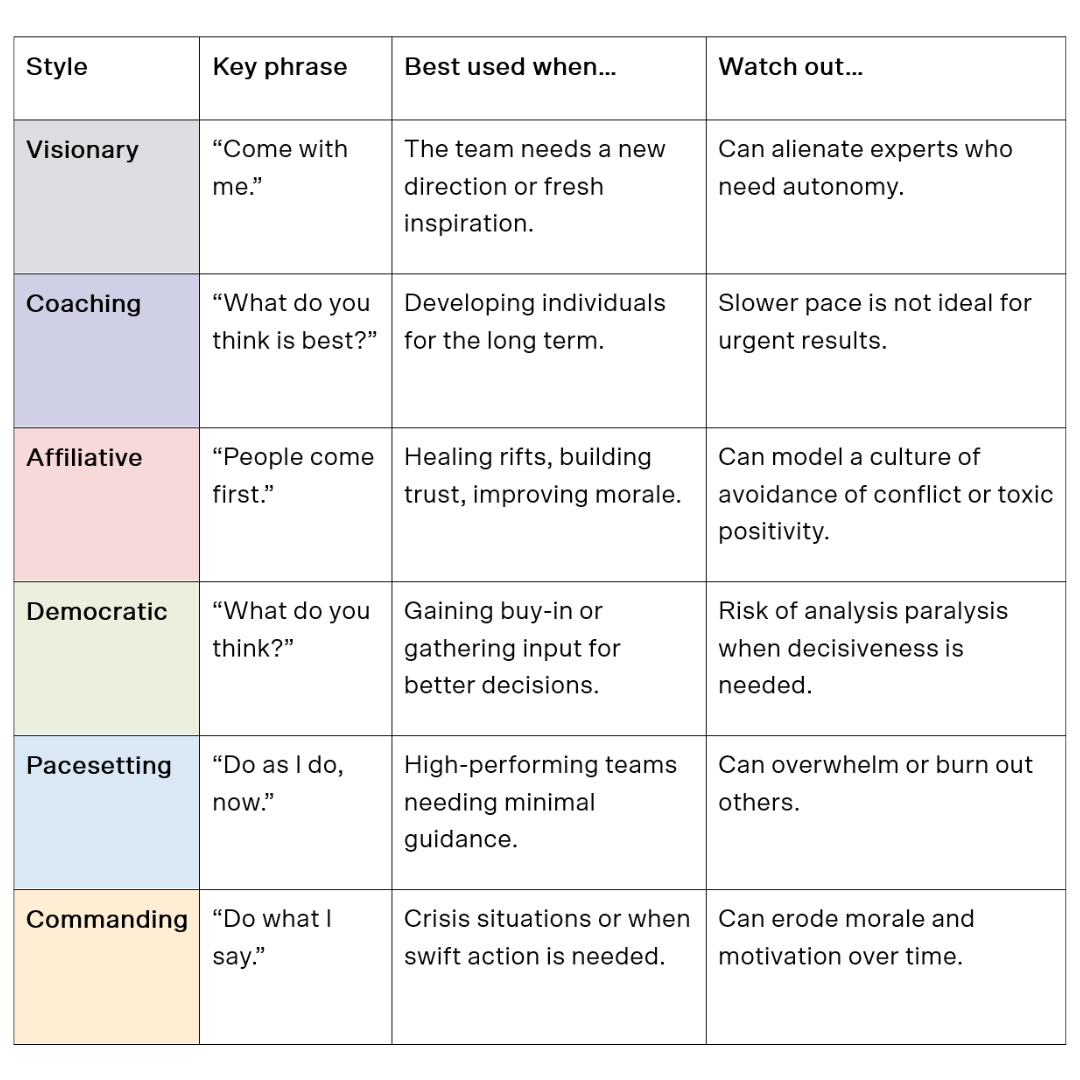
The six leadership styles — what’s yours?
One powerful tool to deepen your self-awareness is Daniel Goleman’s framework of six emotional intelligence-based leadership styles.
Each one has a place, a power, and a potential downside.
Knowing your style
Here are some questions to help you consider which is your default style:
- Which do you think is the most effective way to lead (most of the time)?
- What do you want people to say about your leadership?
- When you have a new challenge or direction to take with your team, what do you prioritise when setting it with them?
We all gravitate toward one or two styles. The key is learning how to flex and knowing when your preferred approach might be working against you.
The most energising and authentic style you can take is to adopt an approach that is grounded in the unique blend of attributes that forms your strengths-based leadership.
That being said, when leading it is still critical to be aware of where your strengths may go into overdrive in pursuit of impact.
Consider which of the above style/s you tend to default to. Now let’s think about the shadow side of your tendencies as a guide on when and how to flex.
Thinking about your chosen style/s:
- What strengths are you most known for and what happens for you when they go into overdrive?
- How might others notice when you’re under stress or pressure in your leadership?
- What unintended consequences have you witnessed or received feedback on when adopting your default leadership style?
What happens under stress
Leadership isn’t tested during “fair-weather” when things are going smoothly, what really shifts is during higher-stakes, higher-stress moments. And this is where anti-habits, the ones that create unintended consequences, can kick in:
- We armour up: becoming more controlling, more agreeable, or more distant.
- We cling to certainty: even if it shuts down new ideas or collaboration.
- We stop listening: especially to those who challenge our thinking.
These are the edges where focus and intention can make a real impact, by adapting our leadership for greatest impact, instead of being governed by the urgency of the moment.
Three ways to grow your leadership range
If you want to grow your clarity, credibility, and impact, here are three practical ways to start:
- Audit your impact
Track your leadership moments over two weeks – what styles are you using, how are they landing across your various team members, have you noticed any unintended consequences? Look for patterns and seek feedback.
- Get feedback you don’t usually hear
Ask people in your team for their honest opinions: “What do I do really well as a leader – and what do I do that might be slowing you down or holding me back?” Practice active listening, curiosity and openness to whatever answers come back.
- Stretch into a new style
Pick an upcoming situation and experiment with a different leadership style. Share your intention with one or two of your team. If you usually coach, try a visionary stance. If you’re highly affiliative, practice setting bold, clear expectations. Reflect on the shift – what works? And what aspects should you continue to strengthen?
“Act like a leader, think like a leader. Doing comes first, knowing second.”
Herminia Ibarra
In conclusion: be the leader you want to be
The best leaders aren’t perfect, but they are intentional.
They own their natural style, stay curious about its limits, and keep evolving their brand to reflect the impact they want to have. That takes self-awareness. It takes courage. And it takes a willingness to lead with your strengths and lean into your stretch.
So, what kind of leader do you want to be – and what’s one shift you’ll make this week to lead with greater intention?

