Building professional and personal resilience
Resilience is more than just bouncing back; it’s the skill that enables us to bend without breaking, to grow and learn through the challenges we experience. It isn’t about simply “coping” or putting up with pressure but about creating the inner and outer resources that help you recover, adapt, and even thrive through uncertainty.
Whether you’re navigating organisational change, handling leadership pressure, or managing life’s curveballs, resilience is your personal and professional anchor. The good news? It’s not fixed. With awareness and action, you can build and strengthen it over time.
Read on for my three top tips.
“Do not judge me by my successes; judge me by how many times I fell and got back up again”
Nelson Mandela
1. What is resilience: The foundation for your success
Resilience is your foundation and core to your success in both your professional and personal life. It is a key skill that will help you with the ups, downs, twists and turns you’ll face in your career and life outside work.
Building & developing your resilience matters because we know through research that it can make you 43% more productive (American Psychological Association), it makes your heart stronger, creates and strengthens your immune system, enables you to recover faster due to better stress management (and lower cortisol levels), lowers your blood pressure, and improves your mental, physical and emotional wellbeing.
One of the most sustainable ways to build resilience is to start with your strengths. Knowing what energises you gives you an anchor in tough times, helping you to bounce back faster and stay resourceful under pressure.
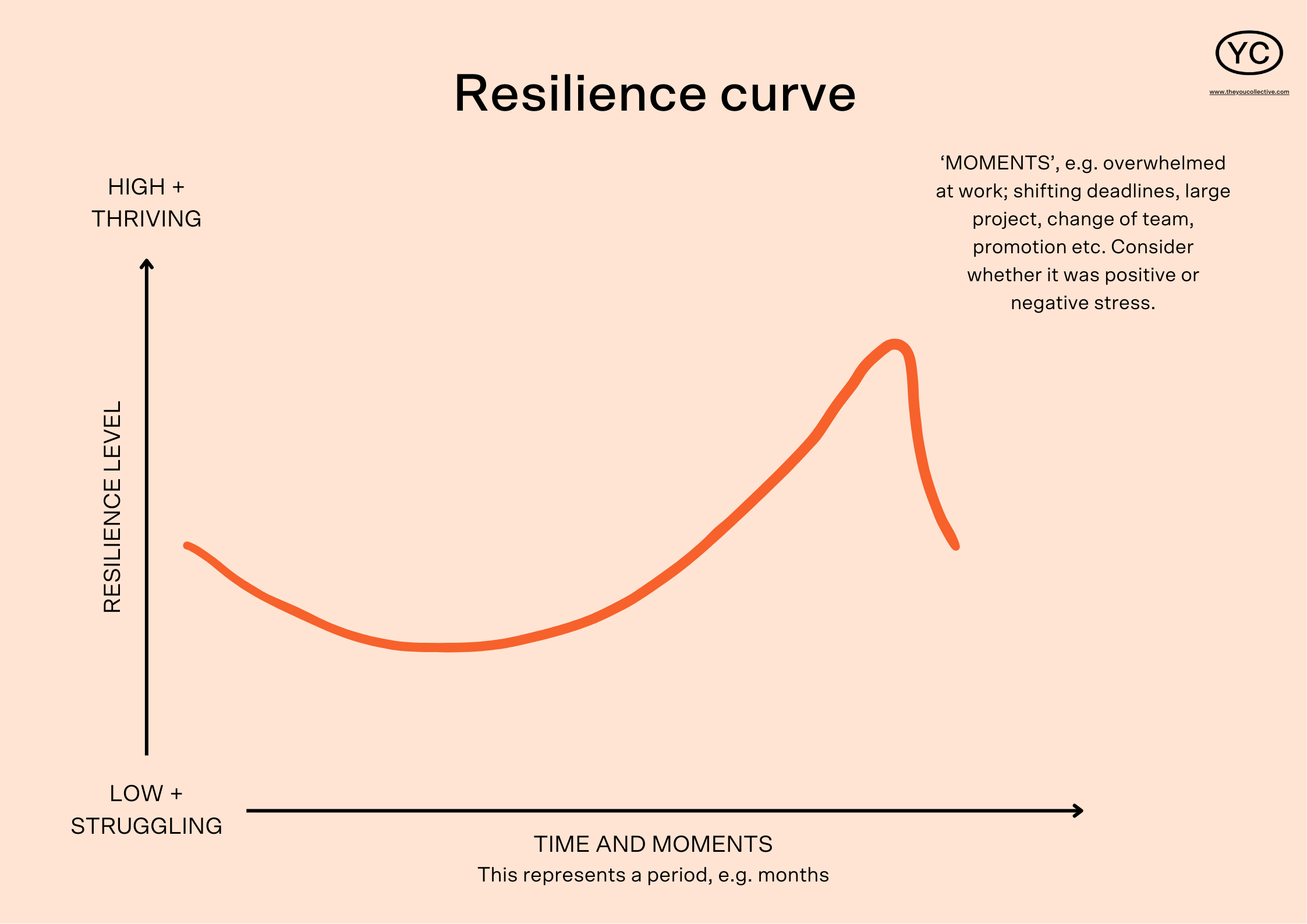
Your past holds the clues to your future strength, so by looking at your ‘Resilience Curve’, you will identify key resilience boosters and blockers.
Part 1
Identify several significant ‘moments’ on the timeline where you faced adversity, intensity, pressure and challenges.
Identify whether your resilience levels were high or low at these times.
As you reflect on these moments, try to ’embody’ the entire experience, including your feelings, emotions, and physical and physiological reactions.
Part 2
1. What patterns do you notice?
2. What are your stress triggers?
3. When was stress a positive for you? What about that ‘moment’ made it positive?
4. What made resilience harder in the lower moments? What helped you to recover?
5. What learnings can you take forward?
2. The chemistry of resilience
Your body fuels or fights resilience as your brain and body react to stress through hormones like cortisol and adrenaline. High cortisol levels can reduce clarity, decision-making, and emotional control when stress is prolonged & too much adrenaline can deplete your energy & increase your anxiety levels.
The key is to manage before it manages you. Micro practices matter here, so small recovery and renewal practices like a 2 minute breathing exercise, stepping outside for fresh air, changing posture) or space to pause are powerful ways to signal safety to your nervous system and recover faster.
On a biological level, you can harness your brain chemistry to build resilience:
- Oxytocin (the connection hormone) is released through building strong relationships and social support.
- Dopamine (the motivation hormone) is released when you set small, meaningful goals to maintain momentum and celebrate progress.
- Serotonin (a mood stabiliser, ‘happy hormone’) is released through exercise, sunlight & gratitude.
Think about what positive habits you currently have, what “daily top-ups” you can do more of which contribute to the release of these hormones which will help create lasting impact.
3. Strengthening your resilience is an active process
You can adopt many different strategies to help you develop your Resting Resilience. It is essential to know what you are already doing that works well for you, and where you need to improve. Focusing on building this will empower and help you cultivate self-efficacy and inner strength to survive and thrive.
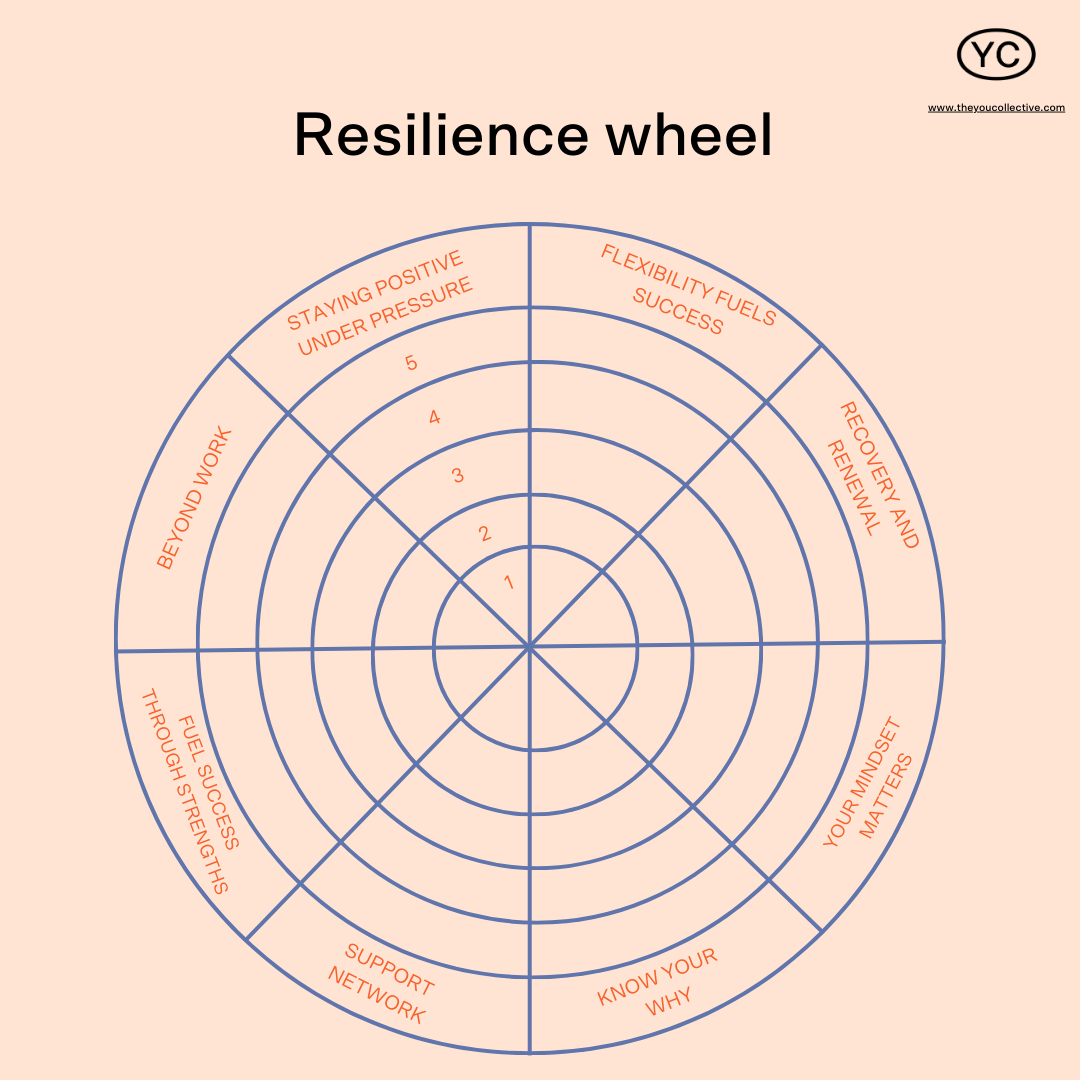
Using the infographic or written descriptions below, give a rating from 1 to 5 in each category – 1 being you’re very under resourced in that area, and 5 being you have high resilience and support.
- Staying positive under pressure
- Being flexible and adaptable
- Building the right processes and approaches to recover and renew your energy (e.g., breathing, movement, boundaries)
- Adopting a growth mindset and checking how you are viewing things
- Know why you get out of bed in the morning (your WHY)
- Having the ‘right’ support network that is diverse to challenge, support and guide you
- Knowing your strengths and what energises you to be motivated and at your best and using these in times of challenge
- Life beyond work and your self-care practices
Now think about:
- What’s your highest scoring area and why? What strategies are you already adopting that means you use internal resources to maintain your resilience?
- What you’re lowest scoring area and why? How does this show up in your body?
- What strategies can you identify that can help you build and strengthen your lowest scoring area so you have access to more internal resources?
Final thoughts
Resilience doesn’t grow by accident. The more actively you experiment and take ownership, the more equipped and in control you’ll feel to handle setbaks and seize opportunities.
So, what do you want to take control of?
What opportunity do you want to seize?
About the author
Maria Salkeld is a leadership development consultant, executive coach, and programme designer with over twenty years of experience in helping leaders and executive teams show up more bravely, connect more authentically, and make an impact with purpose.
Her work is rooted in vertical development and Gestalt principles, with a unique strengths-based approach that brings leadership culture to life across teams and organisations. Maria designs and facilitates leadership programmes that challenge mid to senior leaders to develop in mindset, presence, and effectiveness, especially during periods of growth, complexity, or change.